One of the biggest leadership lessons I’ve learned is that creating a plan and producing a result are two very different things.
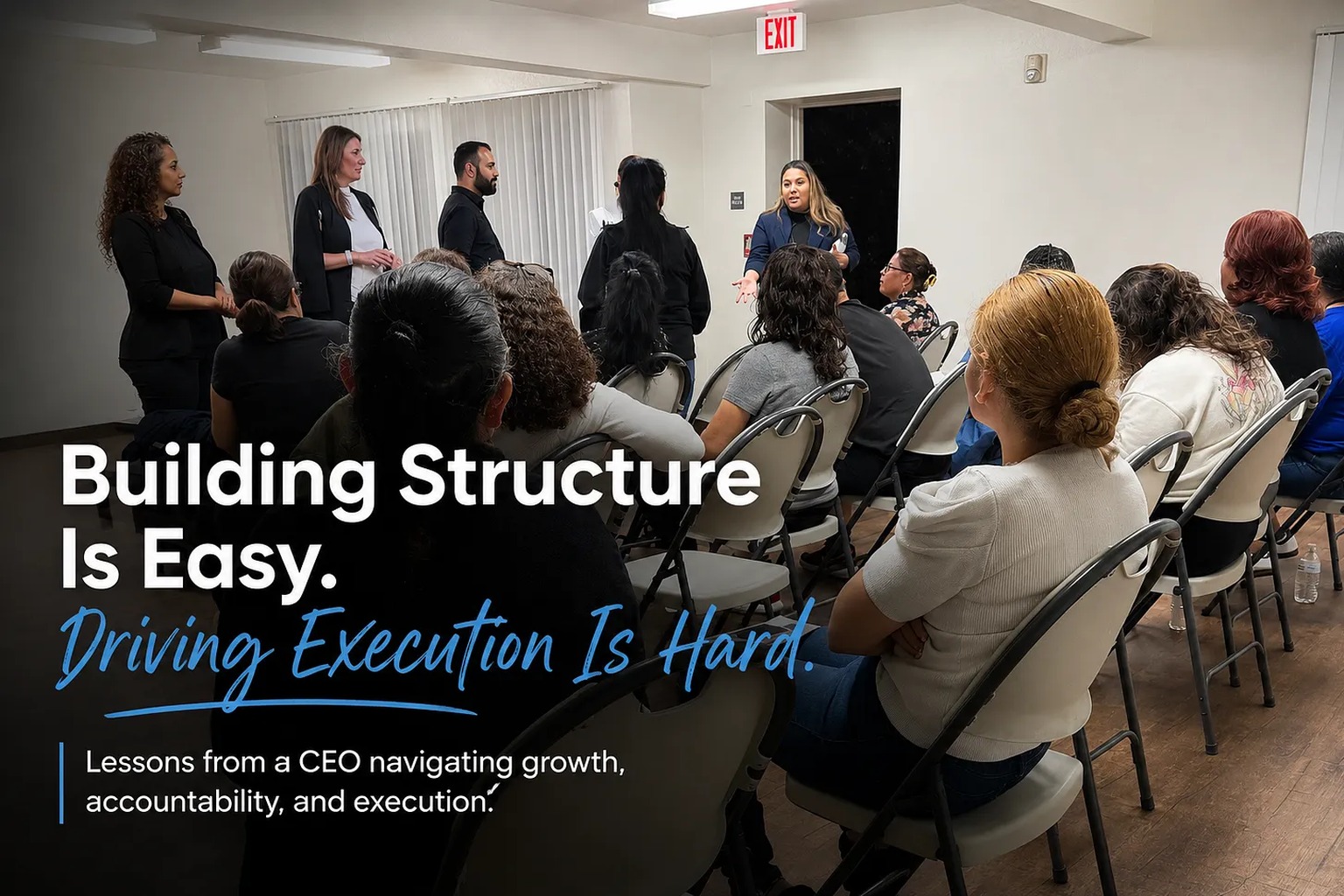
One of the biggest leadership lessons I’ve learned this year is that creating a plan and producing a result are two very different things.
As leaders, we spend a tremendous amount of time building structure. We create operating models, responsibility matrices, communication protocols, reporting systems, accountability charts, and strategic plans. All of those things are important. In fact, many organizations struggle because they don’t have enough structure.
But I’ve learned that structure alone doesn’t solve problems. Execution does.
Over the past several months, I’ve been involved in portfolio stabilization efforts, financial cleanups, compliance challenges, leadership development, and organizational restructuring. In many cases, we identified the problem, gathered the right people, built the plan, assigned responsibilities, and felt confident we were moving in the right direction.
The structure was there.
The roadmap was there.
The accountability was documented.
Yet some of the same issues continued to surface.
That’s when I realized we had moved past a planning problem and into an execution problem.
Activity Is Not Progress
In property management, it’s surprisingly easy to confuse activity with progress.
Meetings are happening.
Reports are being generated.
Action plans are being written.
Emails are being sent.
Spreadsheets are being updated.
Everyone feels busy.
But residents don’t benefit from activity.
Property owners don’t benefit from activity.
Properties improve when work gets completed.
What Happened After the Plan?
One of the most valuable questions I’ve started asking is incredibly simple:
Not what was discussed.
Not what was assigned.
Not what was intended.
What was actually completed?
The answer to that question reveals more about an organization than any meeting ever will.
Recently, I’ve spent a significant amount of time helping teams navigate operational challenges. We identified occupancy concerns. We outlined compliance priorities. We clarified leadership responsibilities. We developed escalation structures and communication expectations.
The breakthrough never came from creating another spreadsheet or another meeting agenda.
The breakthrough came when we stopped discussing the work and started measuring whether the work was actually happening.
A Plan Should Create Confidence, Not Comfort
I’ve also learned something about myself through this process.
As a leader, I love building systems. I enjoy solving complex problems and creating clarity where there is confusion. When a strong plan comes together, there is a natural sense of relief. You can finally see the path forward.
But leadership has taught me that a plan should create confidence, not comfort.
The existence of a plan is not evidence of success. It’s simply evidence that you’ve identified what needs to happen next.
The real work begins after the meeting ends.
Recognizing Patterns Is Not Enough
I’ve also come to appreciate a lesson we recently discussed in CEO University: the difference between reporting issues and recognizing patterns.
Most organizations are good at reporting individual problems.
A resident complaint.
A delinquent account.
A missed recertification.
A vacant unit.
A maintenance issue.
Strong leaders do something different. They step back and look for patterns. They ask why similar problems continue to appear. They focus less on the individual issue and more on the system producing the issue.
But even pattern recognition only takes you so far.
Once the pattern is identified, execution is still required.
The plan still has to be implemented.
The conversations still have to happen.
The accountability still has to be maintained.
The work still has to get done.
Execution Creates Success
The organizations that consistently perform at a high level are not necessarily the ones with the most sophisticated plans. They are the ones that execute consistently, communicate clearly, and maintain accountability long after the excitement of planning has faded.
Structure creates the opportunity for success.
Execution creates success.
As leaders, our responsibility isn’t simply to build the framework.
Our responsibility is to ensure the work moves forward inside it.
Because at the end of the day, no resident, investor, employee, or stakeholder benefits from a great plan.
They benefit from great execution.
Share This Story, Choose Your Platform!
LISTEN NOW

CAPTIVATING READS

Our blog is packed with articles and stories based around lifestyle, business, design and wellbeing. Subscribe now to get all of our updated directly to your inbox every week.